Signed in as:
filler@godaddy.com
Signed in as:
filler@godaddy.com

Neural therapy and perineural injection therapy (PIT) target the inflamed, irritated nerve fibers that keep chronic joint pain, back pain, and fibromyalgia switched on — often after injections, medication, and physical therapy alone haven't held
An MRI can show a disc, a joint, or a tendon — but it can't show a nerve that has become chronically inflamed and hyper-reactive. In many patients with long-standing joint pain, back pain, or fibromyalgia, the peripheral and autonomic nervous system itself becomes a driver of the pain signal, independent of how much tissue damage is actually present.[1]
That's the premise behind neural therapy and perineural injection therapy (PIT): instead of injecting a joint or ligament alone, these techniques inject small amounts of a local anesthetic or dextrose solution directly around irritated superficial nerves and autonomic ganglia — calming neurogenic inflammation and, in many patients, interrupting a pain cycle that has outlasted its original injury.
At NY360 Wellness Medicine, Dr. Adeeti Gupta incorporates neural therapy and PIT into a broader, root-cause approach to chronic pain — one that also looks at systemic inflammation as a driver of symptoms, rather than treating pain purely as a local mechanical event.
Neural therapy, PIT, and prolotherapy aren't the same injection.
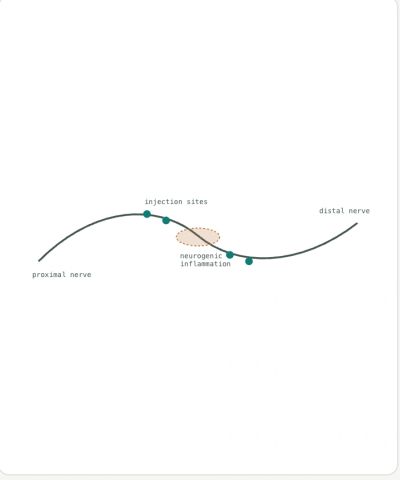
Chronic irritation of a superficial nerve triggers the release of pro-inflammatory neuropeptides (such as substance P) from the nerve endings themselves — a self-sustaining loop sometimes called neurogenic inflammation.[3]
PIT places a series of small subcutaneous 5% dextrose injections around the nerve, above and below the irritated segment, rather than into the joint or muscle. The dextrose concentration is thought to quiet this neuropeptide release without provoking a new inflammatory response of its own.[10]
1. Palpation exam maps tender points along the affected cutaneous nerves.
2. Small-gauge injections of buffered 5% dextrose are placed subcutaneously.
3. Sessions are typically spaced roughly weekly during the active phase.[4]
4. Neural therapy and/or prolotherapy are layered in based on response.
01 / Joint Pain
Prolotherapy has the strongest evidence base of the three techniques for knee osteoarthritis and sacroiliac joint pain, with outcomes reported as comparable to corticosteroid injection in several comparative studies. A randomized trial on rotator cuff tendinopathy found dextrose injection therapy reached comparable or better outcomes than physiotherapy alone, in a shorter course of treatment.
Evidence: PM&R KnowledgeNow review[3]; Caring Medical / J Clin Rheumatol rotator cuff RCT summary[10]
Prolotherapy for chronic low back pain has been studied in controlled trials for decades, with a 2007 evidence review finding support for its use as part of a broader treatment program. A comparative study of PIT specifically for mechanical low back pain, and a randomized trial comparing prolotherapy to epidural steroid injection for pain radiating into the leg, add to a growing evidence base for dextrose-based injection strategies in the spine.
Evidence: Dagenais et al., evidence-informed review[5]; PIT low back pain comparative study[7]; Annals of Family Medicine RCT[6]
Because fibromyalgia is understood to involve central and autonomic nervous system sensitization rather than a single structural lesion, it's a condition where neural therapy's focus on the autonomic nervous system — rather than a specific joint or muscle — is particularly relevant. A published clinical evaluation of neural therapy in fibromyalgia patients reported improvement across pain and quality-of-life measures following a course of treatment.
Evidence: neural therapy in fibromyalgia, clinical evaluation[1]
Neural therapy and PIT are supported by a growing body of case series, retrospective studies, and a smaller number of randomized and comparative trials — but the field, particularly for PIT, is younger and less standardized than research on conventional injections like corticosteroids.[3] Prolotherapy has the longest track record, in clinical use since the 1950s, with the deepest evidence base concentrated in knee osteoarthritis and sacroiliac joint pain.[3]
Reported benefits across these techniques include pain reduction, improved function, and a favorable safety profile relative to corticosteroid injection — but study sizes are often small, follow-up windows are frequently under six months, and dosing protocols vary between practitioners and clinics.[3] We share this directly because an honest picture of the evidence is part of informed consent, not a footnote to it.
A 2019 case series applying an integrated neural therapy + prolotherapy protocol documented substantial improvement in three long-standing cases: a 46-year history of low back pain, a decade-old facial neuralgia, and a masters athlete whose recovery had plateaued on prolotherapy alone until autonomic nervous system dysfunction was addressed first.[8]
Perineural Injection Therapy — also called Lyftogt Perineural Injection Treatment (LPIT) or neural prolotherapy — was developed by Dr. John Lyftogt, a family physician who graduated from Leiden University Medical Faculty in the Netherlands in 1973 and established his practice in Christchurch, New Zealand in 1978.[9]
Drawing on his background in musculoskeletal and sports medicine, Dr. Lyftogt built on traditional dextrose prolotherapy to create a technique specifically aimed at chronic neuropathic pain — becoming, by his own clinic's account, the first to use buffered 5% dextrose (D5W) injections around superficial nerves for this purpose.[9]
Since organizing his first teaching workshop in Christchurch in 2009, Dr. Lyftogt and collaborators have trained more than 3,500 healthcare professionals across over 30 countries, helping establish PIT as a recognized, teachable technique within musculoskeletal and pain medicine rather than a one-clinic method.[9]
Dr. Adeeti Gupta, MD, FACOG, founded NY360 Wellness Medicine on a root-cause philosophy: rather than treating a lab value or a single symptom in isolation, look upstream at what's driving it — inflammation chief among them.[11] Applied to pain management, that same lens is part of why neural therapy and PIT — techniques that specifically target neurogenic inflammation rather than masking pain signals — fit naturally into NY360's broader treatment philosophy.
Neural therapy and PIT are typically offered as part of an individualized plan that may also include prolotherapy and the practice's other regenerative and longevity-focused therapies, so that pain management is coordinated with a patient's overall inflammatory and metabolic picture rather than treated as a separate track.
Is perineural injection therapy painful?
The injections use a fine needle and a small volume of buffered dextrose solution just beneath the skin. Most patients describe a brief stinging or pressure sensation rather than significant pain, and no sedation is required.
How many sessions does it typically take?
Protocols vary by condition and individual response. Published series often describe roughly weekly sessions during an active treatment phase, with the total number of visits determined by how a patient responds along the way.[4]
How is PIT different from a cortisone or steroid injection?
Cortisone reduces inflammation broadly by suppressing immune activity at the injection site. PIT uses a dextrose solution around the nerve itself, aiming to quiet neurogenic inflammation without the tissue-thinning or repeated-use limitations associated with repeated corticosteroid injections.
Can neural therapy and PIT be combined with prolotherapy?
Yes — they're commonly used together as part of a single treatment plan, since each targets a different tissue (nerve vs. ligament/tendon vs. autonomic ganglia). Dr. Gupta determines sequencing and combination based on your evaluation.
Is fibromyalgia specifically responsive to these treatments?
Because fibromyalgia involves autonomic and central nervous system sensitization, neural therapy's focus on the autonomic nervous system is a relevant, evidence-informed option to discuss — though, as with any fibromyalgia treatment, response varies from patient to patient and it is typically used as part of a broader management plan.[1]
Is this covered by insurance?
Neural therapy, PIT, and prolotherapy are generally billed as out-of-network or self-pay services, as is standard for regenerative and functional injection therapies. Our care team can walk you through costs and any applicable superbill documentation at your consultation.
Consultations begin with a full history and exam to determine whether neural therapy, PIT, prolotherapy, or a combination is the right starting point for you.
Copyright © 2026 NY 360 Wellness Medicine - All Rights Reserved.
NY 360 Wellness Medicine is a functional medicine and longevity clinic in New York specializing in hormone therapy, fatigue, weight management, gut health, and preventive Medicine 3.0 care. We provide personalized, physician-led treatment plans using advanced diagnostics and integrative therapies to help people achieve long-term health and vitality.